Check out the best spiral snake plant varieties and learn how to care for them for a beautiful, head-turning indoor display!


Snake plants are like living sculptures! Their upright leaves add a clean, structured look to any space. However, did you know that there are many different snake plant varieties that grow in a spiraling pattern? These can be a perfect addition to your Sanseveria creation!
Best Spiral Snake Plant Varieties
1. Twisted Sister

Botanical Name: Sansevieria trifasciata ‘Twisted Sister’
If you want a plant that naturally curls and spirals without any shaping, this compact variety is perfect. You’ll spot it easily by its short, wavy leaves with bold yellow edges and deep green centers.
Just give it bright but indirect light and it’ll keep thriving. The color and patterns become stronger when it gets enough light. And it looks great on nightstands, shelves, or kitchen counters.
Make sure you water only when the top inch of soil feels dry; this prevents root rot and keeps the curl firm.
Pro Tip: Rotate the pot once a month–it naturally spirals, and a gentle quarter-turn keeps the curl symmetrical without stressing the rosette.
2. Fernwood

Botanical Name: Sansevieria ‘Fernwood Mikado’
This one grows with thin, round leaves that come up like a little fountain. It doesn’t spiral much at first, but over time, you’ll notice a gentle coil forming as it grows taller.
Since its leaves are thinner, keep the soil slightly more evenly moist than the usual snake plant, but again, wait for the potting medium to dry out well before saturating again. Its leaves have tiger-like stripes, giving them a textured look that fits nicely in small spaces or work desks.
Here’s a tip: Plant three small ‘Fernwood’ in one low, wide pot at different heights–it’ll make the spiral effect look fuller without needing any shaping.
3. Mikado

Botanical Name: Sansevieria bacularis ‘Mikado’
You’ll often find this one sold as the Mikado Snake plant. It has pencil-thin, rod-like leaves that grow upright and can bend or spiral slightly as they mature. Many sellers bundle a few stems together for a corkscrew look, and it keeps that shape for a long time.
Just give it filtered or medium light and water only when the soil is nearly dry. Use a tall, narrow pot to match its upright style, as it will highlight the plant’s spiral bundle perfectly.
Pro Tip: If you buy one tied into a spiral bundle, re-tie it gently with soft plant tape. Avoid wire, as it can cut into the foliage over time.
4. Dragon Finger Spiral Snake Plant

Botanical Name: Sansevieria angolensis
This one has several shoots braided tightly into a neat spiral column, often sold as “Dragon Fingers.” It stays compact for years and adds a clean, sculptural look to any shelf or desk.
It’s very drought-tolerant, so you can skip watering occasionally without harm. Just make sure the potting mix drains well and don’t move it into a new pot too often, as its roots prefer staying a bit tight.
Decor Tip: Keep it on tall shelves or sideboards. Its upright, braided shape looks like a living art piece from every angle.
5. African Spear

Botanical Name: Sansevieria angolensis
Here is the classic type often trained into braids or spirals before sale. Naturally, its leaves grow upright and round like spears, but you can train the young shoots into spiral shapes if you’re patient.
It’s very low-maintenance, so water only when at least the top two inches of the soil is dry. Overwatering is the main mistake to avoid. Other than that, bright, indirect light helps keep its shape firm and color deep.
Pro Tip: Keep the braid or spiral loosely tied while it’s growing, then remove tight ties once the stems harden. This prevents scarring or bending.
6. Spiral Queen

Botanical Name: Sansevieria ‘Spiral Queen’
Spiral Queen is actually a hybrid that has leaves that twist and curl as they grow, forming a spiral effect naturally. The foliage often shows strong texture and variegation, which makes the spiral more noticeable.
It’s one of those varieties where you don’t have to put any serious work into getting that lovely spiral shape. Do be careful not to overwater it, though.
Quick Tip: Avoid moving it often–stable conditions help the spirals stay uniform.
7. Sansevieria Patens

Botanical Name: Sansevieria patens
The Patens variety has thick, cylindrical leaves that arch outward in a soft spiral pattern rather than growing straight up. The leaves are usually deep green with faint banding and can reach 1.5–3 feet long.
It’s slower growing, but its spreading form gives a sculptural, balanced look indoors. Make sure you avoid deep pots. A wide, shallow one supports its fan-like shape better.
8. Sansevieria Ballyi

Botanical Name: Sansevieria ballyi
If you are short on space, Sansevieria ballyi is the perfect compact spiral plant for your collection. This miniature variety forms rosettes of narrow, cylindrical leaves that twist and curl as they grow, without any training.
Its slow growth and petite size make it ideal for your windowsills and bookshelves. Unlike the larger species, ballyi will appreciate a bit more warmth and consistent light.
Pro Tip: Give your Sansevieria ballyi a light feed with a diluted succulent fertilizer during spring and summer. This will boost leaf strength and enhance the spiral pattern.
9. Sansevieria Congo
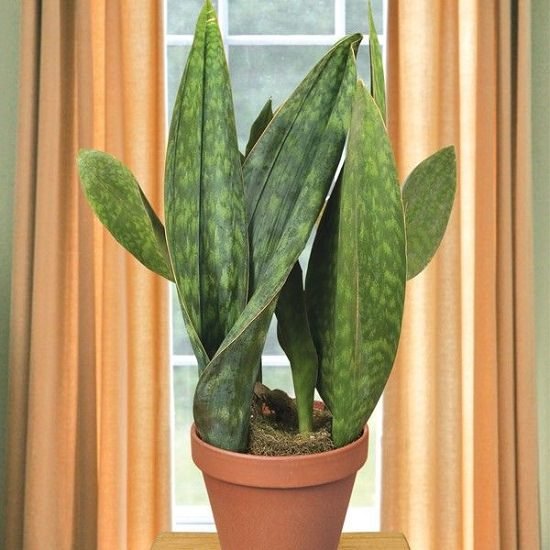
Botanical Name: Sansevieria trifasciata ‘Congo’
Here’s a lovely variety known for its broad, upright leaves that twist subtly at the tips, giving it a gentle spiral form as it matures. Congo’s leaves are wider and thicker, so it looks fuller and more structured.
It does well in medium to bright indirect light and can handle occasional low light. The key is to let the soil dry out completely before watering again. And remember, congo prefers a bit of neglect over attention.
10. Sansevieria Bruda

Botanical Name: Sansevieria bruda
This rare type features cylindrical, dark-green leaves that curve in a tight spiral from the base, creating a compact rosette pattern. It’s slower-growing than most but holds its shape beautifully with little care.
Keep it in a bright corner with indirect sunlight and water sparingly–about once every two to three weeks. It prefers being slightly root-bound, so avoid repotting until absolutely necessary.