
Epsom Hotel Protest Exposes Britain’s Deepening Migration Divide: Beyond the Crowds, What Is Really Driving the Anger?
EPSOM, England — What began as local concern over reports that a hotel in the Surrey town of Epsom was being used to accommodate asylum seekers quickly evolved into a highly charged public demonstration, drawing national attention and reigniting one of Britain’s most contentious political debates: immigration, asylum policy, and public trust in government decision-making.
Videos circulating across social media platforms showed large crowds gathering outside the hotel, chanting slogans, demanding answers, and questioning local authorities about the property’s reported use. As the crowd grew, police established lines to separate demonstrators and maintain public order.
Counter-protesters also arrived, creating a tense atmosphere in which competing visions of Britain’s identity appeared to collide in real time. While some participants argued they were defending local interests and demanding accountability, others stressed the importance of protecting vulnerable people seeking refuge.
Although no major injuries were reported, the images from Epsom quickly spread nationwide, becoming the latest symbol of a migration debate that remains deeply emotional and politically explosive.
Growing Frustration Over Hotel Accommodation
At the center of the controversy is the British government’s continued use of hotels to house asylum seekers while their claims are processed.
As the number of arrivals increased and processing times lengthened, hotels became a temporary solution.
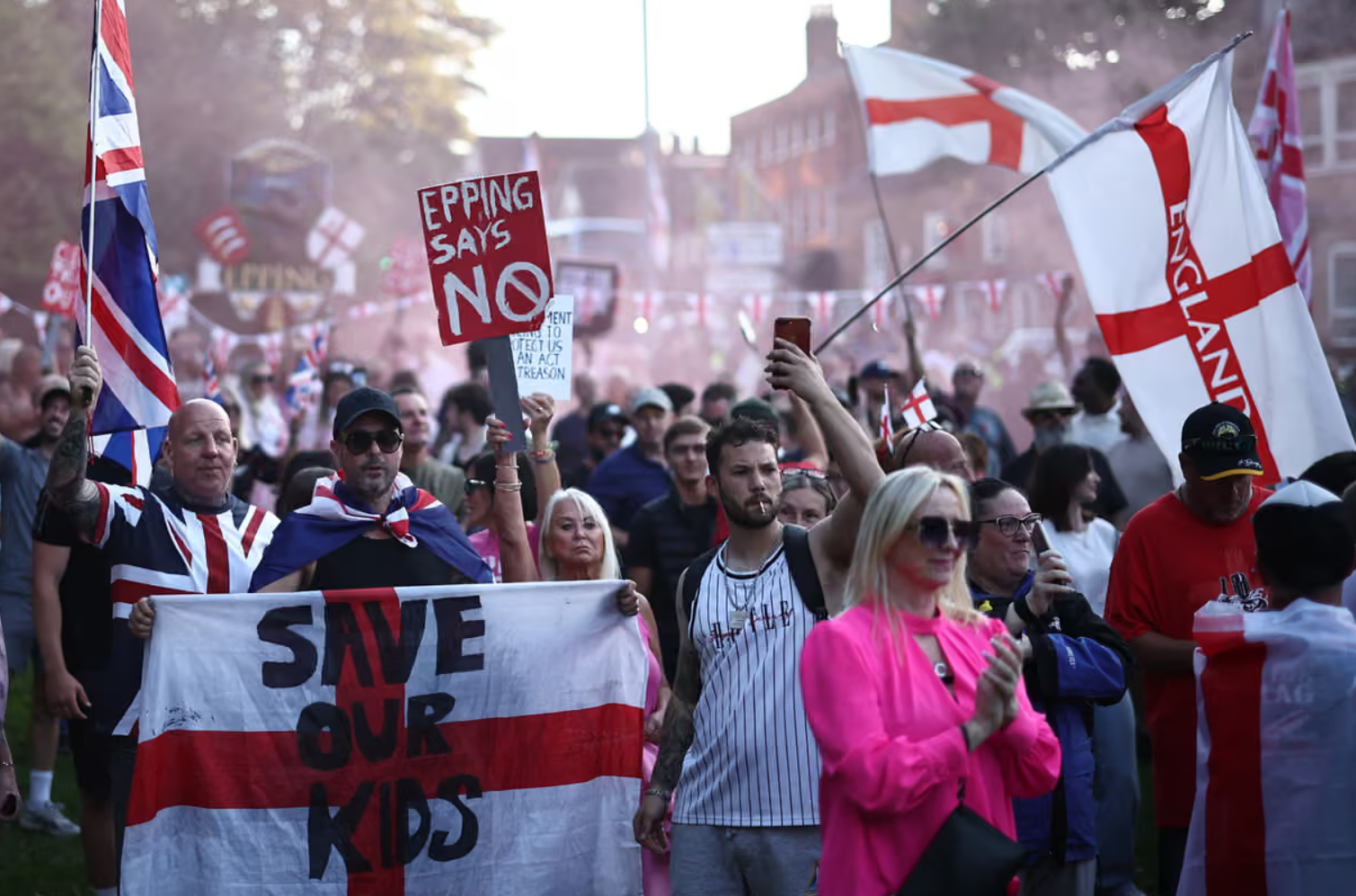
Government officials have repeatedly argued that the arrangement is necessary to meet humanitarian obligations. However, critics argue that what was originally presented as a temporary emergency measure has evolved into a costly and politically damaging long-term policy.
Residents in Epsom voiced concerns that decisions affecting their community were made without sufficient consultation. Many claimed they received little information about the situation and felt excluded from discussions regarding local impacts.
Their concerns extended beyond the hotel itself.
Many residents cited pressures on housing availability, healthcare services, schools, and local infrastructure. Whether these pressures are directly attributable to asylum accommodation or reflect broader national challenges remains a matter of debate, but the perception of strain has become politically significant.
In many communities across Britain, perception often shapes public reaction as powerfully as verified facts.
The Role of Rumors and Misinformation
One particularly notable aspect of the Epsom protest was the role played by rumors.
Initial reports circulating online suggested specific details about the hotel’s use, helping mobilize residents and activists. Some of those claims were later clarified or challenged, raising questions about how rapidly information—and misinformation—can spread during highly emotional situations.
The Epsom case demonstrates a broader pattern seen repeatedly across Britain in recent years.
Information shared through social media frequently travels faster than official communication. By the time authorities provide clarification, public opinion may already have hardened.
This communication gap has become a recurring feature of asylum-related controversies.
Many local residents say they feel government agencies often provide information too late, while officials argue that premature disclosures can create security concerns or compromise operational planning.
The result is often a vacuum filled by speculation.
A National Debate Reaches Local Streets
The scenes witnessed in Epsom are not isolated.
While each protest has its own local context, common themes continue to emerge:
- Concerns about immigration levels.
- Questions regarding public spending.
- Anxiety over housing shortages.
- Frustration about government transparency.
- Broader debates over national identity and social cohesion.
For many protesters, the issue extends beyond a single hotel or individual community.
The demonstrations reflect a belief that Britain has lost control of its borders and that local communities are being asked to absorb decisions made far from the places most directly affected.
Others strongly reject that interpretation.
The debate has therefore become not only a policy argument but also a moral one.
Political Pressure on the Labour Government
The controversy arrives at a politically sensitive moment for Prime Minister Keir Starmer’s Labour government.
Labour has pledged to end the widespread use of asylum hotels, describing the inherited system as both expensive and unsustainable.
Officials say efforts are underway to accelerate asylum processing, expand alternative accommodation arrangements, establish new reception facilities, and improve returns agreements with foreign governments.
Yet translating those promises into practical results has proven difficult.
The government continues to face pressure from multiple directions.
Conservative politicians and Reform UK figures argue that the administration has failed to restore effective border control. They claim that British taxpayers are bearing enormous costs while local communities experience growing pressure on services.
Public opinion polling consistently ranks immigration among the country’s most important political concerns.
At the same time, refugee advocates argue that the government must uphold Britain’s legal and humanitarian obligations. They caution against policies driven primarily by public anger rather than long-term effectiveness.
This political balancing act has become one of the defining challenges facing modern British governments.
The Human Dimension Often Lost in the Debate
Amid political arguments and public demonstrations, the individuals living inside these hotels are frequently overlooked.
Many asylum seekers currently housed in Britain originate from countries such as Afghanistan, Iran, Eritrea, and Sudan.
Some have fled armed conflict.
Others have escaped political persecution, imprisonment, or threats to their safety.
Their legal status remains unresolved while their applications move through an often complex and lengthy asylum process.
For supporters of asylum accommodation programs, this reality is essential to understanding the issue.
For critics, humanitarian considerations must be balanced against concerns about national capacity, border security, and taxpayer costs.
The challenge for policymakers is that both perspectives resonate with different segments of the population.
Economic Questions Continue to Fuel Anger
Perhaps no aspect of the debate generates stronger reactions than cost.
The use of hotels has required substantial government expenditure through contracts with private accommodation providers.
Critics point to reports describing significant taxpayer spending and argue that such resources could be directed toward housing shortages, healthcare services, or other domestic priorities.
Supporters of the current system counter that the costs are partly a consequence of systemic delays.
According to this view, faster processing and more efficient case management would reduce reliance on expensive temporary accommodation.
In other words, the hotel issue may be less a cause of the crisis than a symptom of deeper administrative problems.
Police Caught Between Competing Rights
Law enforcement agencies face an exceptionally difficult task during these demonstrations.
Previous protests elsewhere in Britain have resulted in arrests, assaults on officers, public order offenses, and, in some extreme incidents, allegations involving attempted arson.
Although the Epsom demonstration remained largely contained, authorities remain aware that emotions surrounding migration can escalate rapidly.
Maintaining public confidence while avoiding accusations of political bias represents a constant challenge for policing operations.
Community Leaders Call for Calm
As tensions rose, community leaders urged restraint.
Many acknowledged that concerns regarding local resources and public services deserve serious discussion.
At the same time, they warned against broad generalizations about asylum seekers and encouraged residents to separate legitimate policy debates from hostility directed at individuals.
These calls for dialogue reflect a broader concern shared by many observers.
The longer immigration remains framed primarily through confrontation and crisis, the more difficult meaningful solutions may become.
My Professional Perspective
After covering immigration, social unrest, political polarization, and government policy debates for more than three decades, I believe the Epsom protest reveals something far more significant than a disagreement about one hotel.
Much of the public discussion focuses on asylum seekers themselves, but I suspect that many people standing outside that hotel were expressing frustrations that extend well beyond immigration.
They were expressing frustration with institutions.
Frustration with politicians.
Frustration with decision-making processes they feel excluded from.
Frustration with economic pressures that have accumulated over many years.
Immigration often becomes the visible focal point because it is tangible. People can see a hotel. They can see arrivals. They can see demographic changes.
What they cannot easily see are the policy failures, bureaucratic delays, housing shortages, infrastructure challenges, and economic pressures that often contribute to public dissatisfaction.
As a result, immigration debates frequently become a vessel for broader anxieties.
The Question Many Are Not Asking
One question receives surprisingly little attention:
Why has public confidence become so fragile that rumors can mobilize large crowds within hours?
The answer may reveal more about modern Britain than the immigration issue itself.
When citizens believe official information arrives late, lacks transparency, or minimizes legitimate concerns, alternative narratives fill the gap.
Sometimes those narratives are accurate.
Sometimes they are not.
Either way, trust erodes.
Once trust disappears, every government decision becomes harder to implement.
Two Truths Can Exist Simultaneously
One of the most overlooked realities in this debate is that two seemingly conflicting truths can coexist.
It is possible that asylum seekers genuinely need protection.
Acknowledging one reality does not require denying the other.
Yet political discourse increasingly pressures people to choose sides.
The result is polarization rather than problem-solving.
The Epsom protest demonstrated how quickly nuanced concerns can become absorbed into broader ideological battles.
The Deeper Symbolism of the Hotel
The hotel itself has become a symbol.
For some residents, it symbolizes loss of control.
For politicians, it symbolizes policy failure.
For taxpayers, it symbolizes public spending.
For asylum seekers, it may symbolize uncertainty and temporary survival.
Different groups are looking at the same building and seeing entirely different stories.
That is why the issue remains so emotionally charged.
The Challenge Facing Any Government
Whether led by Labour, Conservatives, or any future administration, Britain faces a difficult reality.
The public wants reduced costs.
The public wants secure borders.
The public wants humane treatment of refugees.
The public wants faster processing.
The public wants community consultation.
The public wants legal compliance.
Meeting all those expectations simultaneously is extraordinarily difficult.
Politicians often promise simple solutions because voters prefer clarity.
The reality is rarely simple.
What Happens Next?
The unanswered questions remain substantial:
- Can the government genuinely eliminate asylum hotels?
- Can processing times be reduced sufficiently to prevent future backlogs?
- Can local communities be included more effectively in decision-making?
- Can public trust be rebuilt?
- Can political leaders lower the temperature of the debate rather than intensify it?
The answers to these questions will likely determine whether Epsom becomes a temporary controversy or part of a much larger pattern.
Because if underlying frustrations remain unresolved, similar protests will almost certainly emerge elsewhere.
And each new confrontation risks deepening divisions that become increasingly difficult to repair.
Conclusion
The protest outside a hotel in Epsom may appear at first glance to be a local dispute about asylum accommodation.
In reality, it reflects some of the most profound questions facing modern Britain.
Questions about borders.
Questions about identity.
Questions about fairness.
Questions about public trust.
The scenes witnessed in Surrey were not merely about one building or one group of people. They represented a collision between competing visions of Britain’s future, played out on a local street but carrying national significance.
The challenge now is whether leaders, communities, and citizens can move beyond anger and slogans toward practical solutions.
Because while protests eventually disperse and headlines fade, the underlying issues remain.
And perhaps the most important question is this:
If both local residents and asylum seekers believe they are being failed by the system, is the real problem not the people on either side of the barricades—but the system itself?


