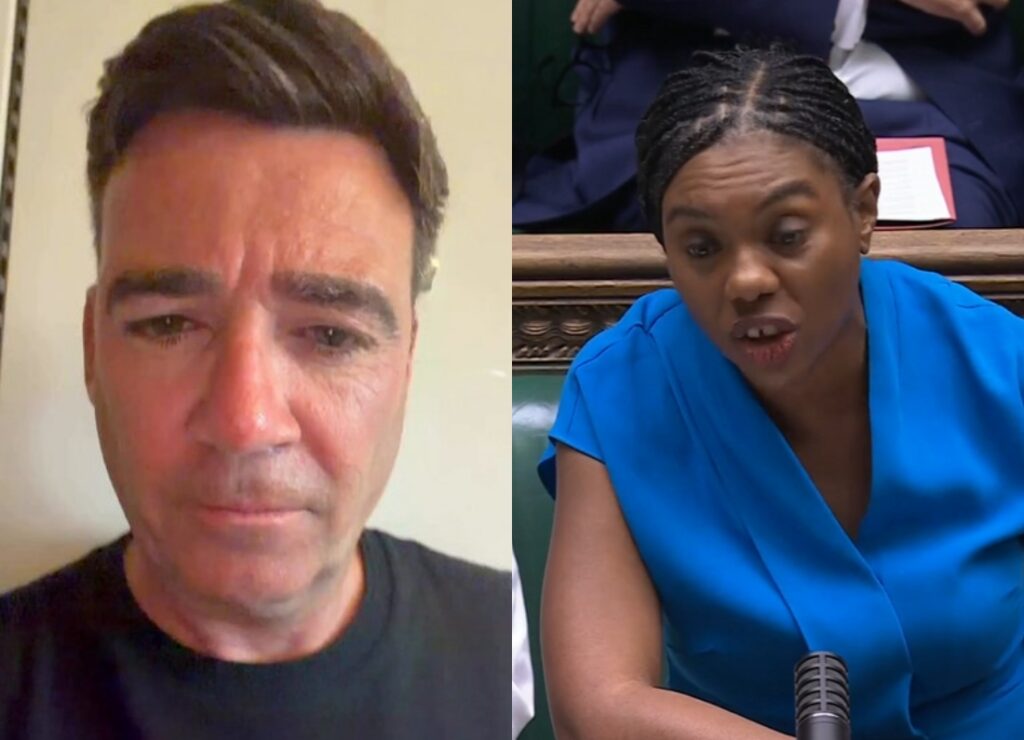
Jeremy Corbyn worked alongside both Keir Starmer and Andy Burnham at senior level during his Labour leadership. Starmer was shadow Brexit secretary. Burnham was shadow home secretary. On Novara Media, interviewed by Michael Walker, Corbyn offered the most substantive assessment yet from someone who knows both men well of whether the incoming prime minister represents genuine change or, as Kemi Badenoch memorably put it, “just a pair of eyelashes and a black t-shirt.”
His answer was careful but clear. “They’re very very different characters in a lot of ways. At a personal level, Starmer is quite buttoned up and not very communicative, whereas Andy Burnham is the opposite of that – congenial to chat to and has quite a wide range of interests, which is good.”
The theater of the transition
Corbyn was characteristically sardonic about what he had been watching at Westminster since Starmer’s resignation. He described Burnham arriving “with a helicopter escort for his train” and then a “massive photo call for Labour MPs who were literally running through Westminster Hall to make sure they were in the shot.” He observed that these were “people who only a few days ago were declaring their all for Starmer.”
“It’s been sort of weird theater going on all around,” he said. “And I’m not quite sure where this is going to end, but it seems to me the sadness of it all is that there’s no analysis going on of either the economic, social, or moral failings of the government under Starmer or any real discussion about what policy changes Andy Burnham may or may not bring in.”
His broader concern: the public are watching this as spectators rather than participants. “It’s like they’re all spectators in their own future. It’s not healthy. There ought to be a proper political debate and that would be best served if there was a contest.” He was careful to note that as someone no longer in the Labour Party, the leadership contest was not his business – but that getting a new prime minister without any public opportunity to scrutinise their stall was “a little strange.”
What he knows about Burnham
Corbyn and Burnham debated on around 45 occasions during the 2015 Labour leadership contest. At a personal level, he says, they have always got along. “He is therefore a much more pleasant person to deal with than many others.” They disagreed on nuclear weapons, defence policy and some aspects of public ownership. Corbyn offered him a shadow cabinet position after winning the leadership; unlike Yvette Cooper and Liz Kendall, Burnham said yes.
On the 2016 chicken coup – when most of the shadow cabinet resigned to try to force Corbyn out – Burnham did not resign. Corbyn is measured about reading too much into that. “Motives, you’ll have to ask him. But he did behave in a decent way within the shadow cabinet, which is a lot more than can be said for many other people.” The fact that Burnham was preparing to run for Greater Manchester mayor at the time, and needed Labour members to view him as a loyal figure, is the alternative explanation Walker put to him. Corbyn neither confirmed nor dismissed it.
His most pointed observation about Burnham is the absence of a clear political statement. “One of the rumors I heard last night, which pleased me quite a lot, was that he was going to go big time on devolution to English regions – moving government offices, resources and facilities to Manchester, Newcastle, and so on. I agree with that. I do think we’re an overlondoncentric country. But that of itself doesn’t deal with the fundamental issues about poverty, inequality, and injustice in our society.”
He also flagged concerns about what the Starmer government’s record constrains: the routine attacks on civil liberties through successive pieces of legislation, and what he called “the disgraceful complicity in the genocide in Gaza.”
The campaign against Miliband
The section of the interview that generated most interest was Corbyn’s response to the campaign against Ed Miliband becoming chancellor, with GMB and Unite among those raising objections. “I think it’s quite shocking actually that people should say he’s not fit to do the job. Clearly Ed Miliband has a great deal of knowledge and experience.”
His reading of what the campaign against Miliband is really about: “I take it as a cipher for this consensus of the centre and right in British politics that we’ve got to ditch the whole environmental agenda in favour of more drilling for gas and oil, more reliance on fossil fuels, less investment in sustainable energy.” He was direct in his challenge to Sharon Graham, the Unite general secretary who suggested Miliband would be a noose around job creation: “I just invite Sharon and anyone else to think for a moment of what they’re saying there. There’s a great deal of jobs to be created out of sustainable energy. There’s an awful lot of investment we can make.”
He noted that Miliband’s pursuit of net zero by 2030 was the real target, and that this represented a “right-wing backlash against the issues of sustainability” rather than a principled objection to his economic competence. On the fiscal rules Rachel Reeves had set for herself, Corbyn was equally blunt: “Fiscal rules that they invented for themselves are fiscal rules that actually year on year increase the number of very poor people in our society.”
The Gaza tribunal
The second part of the interview focused on Corbyn’s new book documenting the proceedings of the Gaza tribunal he organised through the Peace and Justice Project. Held over two days at Church House in Westminster with 29 expert witnesses, and followed online by large numbers of people, the proceedings are now being published in book form with a foreword chapter by Sally Rooney on the concept of genocide.
“The very least the government could do is do what Gordon Brown did with the Chilcot inquiry,” he said – an examination of how Britain ended up in a position of supplying weapons to the IDF while knowing they would be used to bomb hospitals and schools in Gaza. Corbyn has been pursuing accountability through multiple channels simultaneously, including Ofcom complaints over media coverage of his record and the private members’ bill – currently tabled for September 11th – to set up a formal parliamentary inquiry.
On whether he had hope for a change in UK government policy: “I’m always hopeful because I’m fundamentally an optimistic person.” The government, he said, had “been pushed onto the back foot about weapon supplies.” What still needed to come out was the question of the F-35 components made in Britain, the use of the RAF base at Akrotiri, and the intelligence gathered from overflying Gaza that he believes was shared with the IDF to assist bombing targets. “These are very very serious issues and we are not going to give up on it and not going to be silent on it.”
The bottom line on Burnham
Corbyn’s assessment of the incoming prime minister is neither an endorsement nor a dismissal. He credits Burnham with being a more open, communicative person than Starmer; with having a genuine commitment to devolution that could be transformative; and with at least having behaved decently in the shadow cabinet during difficult circumstances. The early polling shows Labour pulling ahead of Reform under Burnham for the first time in a year, which is the kind of evidence that focuses minds.
But his core concern is structural rather than personal. Without a genuine contest, without a public debate, without any requirement to set out a programme before taking office, Burnham will walk into No 10 with a mandate defined entirely by the parliamentary party rather than by the people he is being asked to govern. Whether the devolution agenda, the Miliband appointment – if it happens – and the opening months of his premiership will provide the substance that the leadership process has not is the question Corbyn, like many others on the left, is waiting to see answered.
You can watch the clip below: