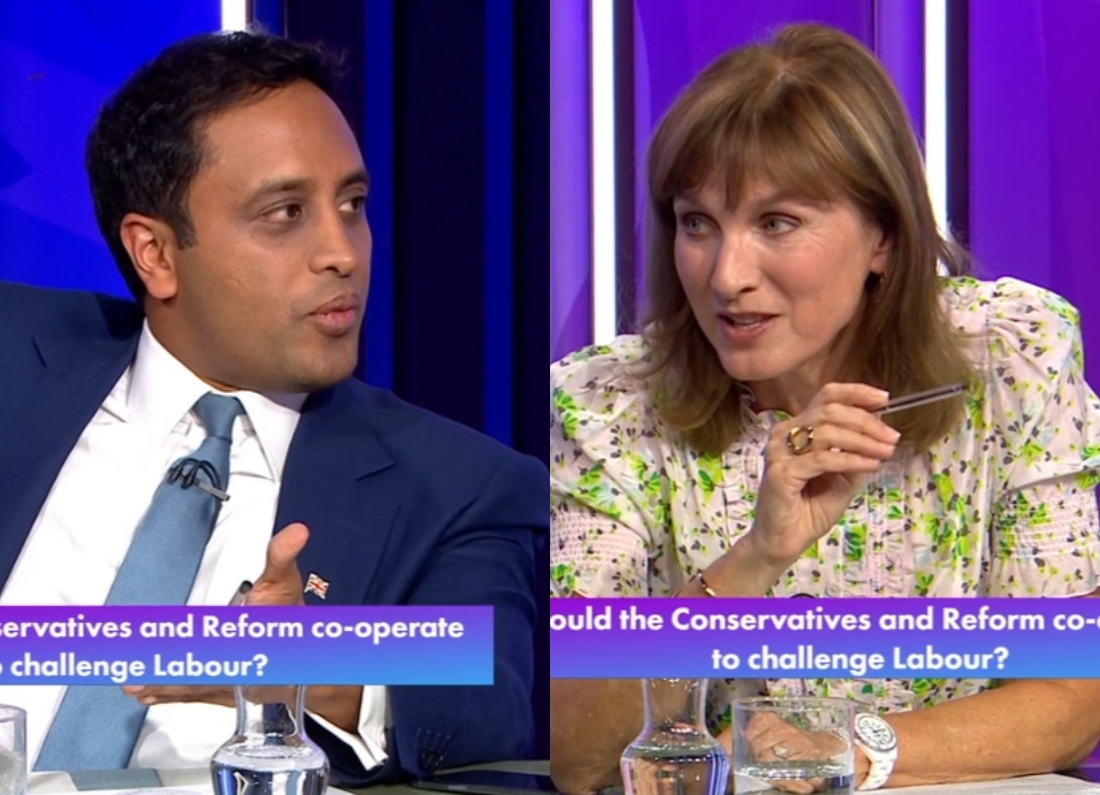
Zia Yusuf’s Question Time appearance began with him clashing with Fiona Bruce over BBC bias and ended with him unable to answer whether his own party had blocked him from standing as an MP. The audience’s reaction to his silence told its own story.
The exchange was triggered by Conservative Party chairman Kevin Hollinrake, who pointed out the apparent contradiction in Yusuf routinely criticising career politicians and elected officials while having never himself stood for public office. “Why have you not stood in some of the by-elections, the opportunities you’ve had round the country to get elected?” Hollinrake asked.
The exchange
Yusuf’s initial response was evasive. “It is interesting that you think all of the country’s problems seem to be down to whether I have stood in a by-election or not. What makes you think I never put myself above the parapet?” Presented with the fact that he had not been named as a candidate in any by-election in recent years, Yusuf replied: “So anybody that wishes to stand in a by-election automatically gets the chance to do so. Maybe that is what happens in the Conservative Party where it is just cronyism and nothing else matters, mate, but I think you have made a lot of big assumptions.”
He added: “We have a process for standing in parliamentary by-elections and all I would say is that coming after me for not standing in a parliamentary by-election is incorrect and hugely presumptuous.”
Hollinrake’s follow-up was simple: “Did they reject you?” The audience burst into laughter and applause.
Bruce then stepped in with what would become the decisive moment. She gave Yusuf every opportunity to close the question down. “Just to be clear because this is new information, what you are telling us tonight Zia is that you have requested to stand in a by-election but you haven’t been selected.” His response – “What I am telling you is that the presumption that I have not put myself forward is a presumption and it is inaccurate” – was not a denial.
Bruce pressed once more: “I am taking from what you have said that you have put your name forward to stand in a by-election but you have not been selected. If I am wrong tell me now.”
Yusuf remained silent.
What the silence means
In political broadcasting, silence in response to a direct invitation to deny something is as close to confirmation as you can get without a formal statement. Bruce’s formulation was precise: she summarised what she believed she had just heard, said it clearly, and told him she would retract it immediately if she was wrong. He said nothing.
Reform has not commented on which by-election Yusuf put his name forward for or why he was not selected. The party has run candidates in a number of recent contests including Makerfield, Gorton and Denton, and several others. The question of why its most prominent broadcast spokesman has not been put forward as a candidate in any of them has now been asked publicly and not answered.
The context around Yusuf
The Question Time appearance was the latest difficult outing for a man who has had a consistently turbulent few months. Reform insiders publicly called for his removal after the Makerfield defeat, calling him “a big problem” and blaming him for pushing the party’s strategy in a direction that contributed to their worst byelection night since the general election. He has been in a public spat with colleague Robert Jenrick over immigration policy. His account of the Nowak family’s wishes on Kuenssberg’s programme was factually challenged. And his Belfast posts drew a comparison to 1930s antisemitic rhetoric from Zack Polanski.
The rejection question is not new – it has been asked in various forms before – but it has never before been asked with this level of specificity on live national television, with the audience laughing, and with Bruce providing a clean and direct formulation that Yusuf chose not to contradict.
Question Time’s record with Reform
This was not the first time Question Time has produced a difficult moment for a Reform representative. An audience member demolished Jenrick over a catalogue of Reform and Tory scandals in a “grifters like YOU” exchange that spread widely. Danny Kruger was unable to answer the “party of billionaires” challenge twice in the same programme. Robert Kenyon was roasted for his views on career politicians at Question Time in Makerfield.
There is a pattern here that goes beyond audience balance claims. Reform’s broadcast representatives are regularly put in positions where they are asked to defend specific things – donor relationships, candidate records, personal track records, policy positions – and struggle to provide coherent answers. The audience reactions to those struggles are not manufactured. They are the natural response to watching someone unable to answer a direct question.
The BBC bias prelude
That this followed Yusuf’s earlier confrontation with Bruce over audience balance gives the episode an additional layer. He had earlier counted eight raised hands and implied the BBC was being dishonest about the audience composition, prompting Bruce to say she was “certainly not lying.” Having spent part of the programme accusing the presenter of misleading the public, Yusuf then found himself silent when Bruce gave him a direct opportunity to deny the most damaging thing said about him all evening.
The Reform strategy of challenging BBC impartiality tends to be most useful as a defensive posture – a way of pre-emptively questioning any critical coverage. It is considerably less useful when the credibility of the presenter has been established and she is asking you a simple factual question about your own career.
Yusuf did not specify which by-election he had attempted to stand in. He did not say whether he had been rejected. He did not contradict Bruce’s summary of what he appeared to have admitted. He was silent – and on Question Time, watched by millions of people, that silence was the story.