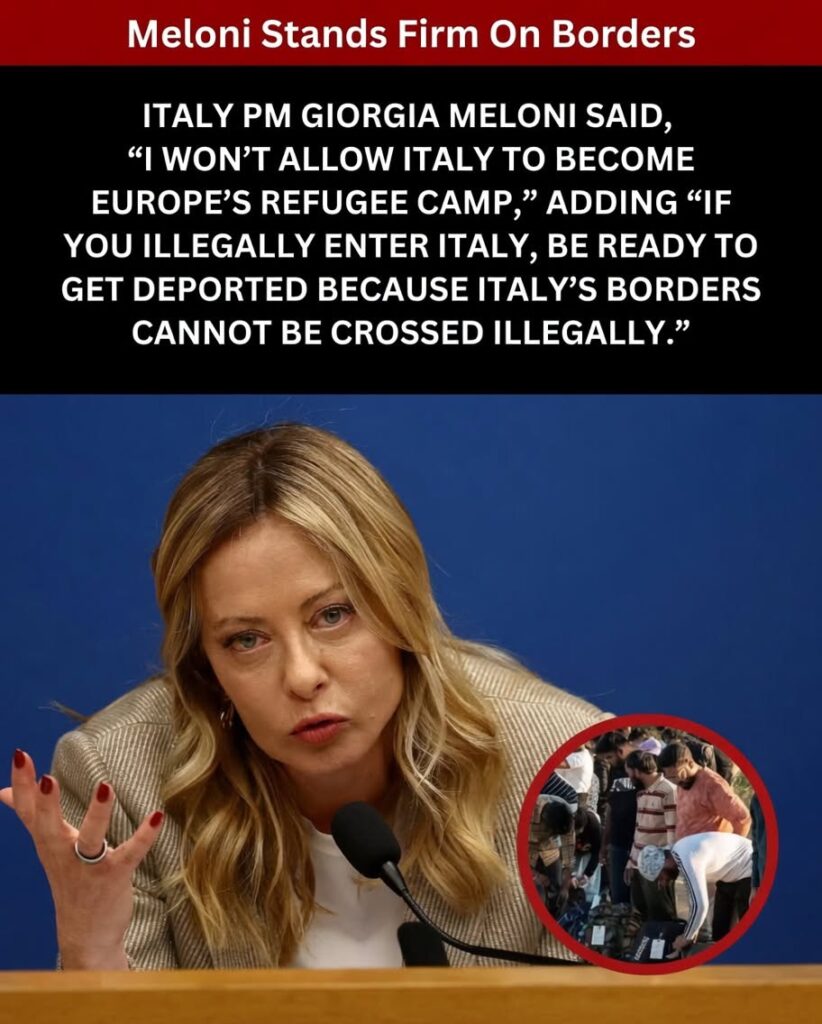
Italian Prime Minister Giorgia Meloni has once again reaffirmed her government’s commitment to strict immigration policies, repeating that Italy’s borders must be protected and that irregular migration should be addressed through firm enforcement combined with legal migration pathways. Her remarks have reignited debate both within Italy and across Europe.
Speaking about migration policy, Meloni argued that Italy cannot shoulder a disproportionate share of migration pressures. She reiterated her government’s long-standing position that irregular entry into the country should not become an accepted route to permanent residence.
Among her most widely discussed remarks was her statement that she would not allow Italy to become “Europe’s refugee camp.” She also repeated that people who enter Italy illegally should face the legal consequences established under Italian immigration policy, including deportation where permitted under applicable law.
Meloni has consistently maintained that every sovereign nation has both the right and the responsibility to protect its borders. According to her government, effective border management is essential for maintaining public confidence, ensuring national security, and preserving an orderly immigration system.
Supporters of the Prime Minister welcomed her comments, arguing that stronger border controls are necessary to discourage dangerous irregular migration routes and reduce the influence of criminal smuggling networks operating across
the Mediterranean.
Many supporters also believe that immigration systems function more effectively when legal migration channels are clearly distinguished from unauthorized entry. They argue that governments must be able to enforce immigration laws while maintaining fair procedures for those seeking lawful entry.
Critics, however, contend that migration policy must always remain consistent with Italy’s constitutional obligations, European Union law, and international refugee protections. Human rights organizations continue to stress that individuals seeking asylum are entitled to have their claims examined according to established legal procedures.
Italy has remained one of the principal arrival points for migrants attempting to reach Europe by sea. As a result, migration has become one of the defining political issues in Italian public life, influencing elections, coalition politics, and Italy’s relationship with other European Union member states.
Meloni’s administration has introduced or supported a number of measures aimed at strengthening border enforcement, expanding cooperation with countries of origin and transit, accelerating immigration procedures, and reducing irregular arrivals. Government officials argue these initiatives form part of a comprehensive migration strategy.
Opposition parties have proposed different approaches, emphasizing greater European cooperation, expanded legal migration pathways, improved asylum processing, and stronger humanitarian protections. They argue that migration is a shared European challenge requiring coordinated international solutions.
Political analysts observe that immigration remains one of the most divisive issues across Europe. Governments continue to debate how to balance national sovereignty, border security, humanitarian responsibilities, labor market needs, and international legal commitments.
Legal experts point out that migration policies adopted by member states remain subject to judicial review where questions arise concerning constitutional protections, European Union law, or international conventions governing refugees and human rights.
The Prime Minister’s latest comments have generated extensive discussion across traditional media and social media platforms. Supporters describe her position as a firm defense of national sovereignty, while critics argue that the language used in migration debates can influence public attitudes toward migrants and refugees.
Whether praised as a necessary response to irregular migration or criticized as an overly restrictive approach, Giorgia Meloni’s position continues to shape political discussion both inside Italy and throughout Europe. As migration remains one of the continent’s most significant policy challenges, debates over border security, legal migration, humanitarian obligations, and the rule of law are expected to remain central to European politics for the foreseeable future.