

In a heated discussion on GB News, commentators argued that Nigel Farage is rapidly building an insurgent movement driven by voters who feel abandoned by the political establishment. The comparisons to America’s MAGA movement have intensified as Reform UK continues to gain traction, while both Labour and the Conservatives struggle to contain growing public frustration.
Much of the discussion focused on the idea that Farage is assembling a powerful coalition built on long-term grievances: working-class frustration, anxiety over migration, anger over the cost of living, cultural resentment, and what some described as deep contempt for establishment politicians.
This political formula mirrors the movement that helped propel Trump into office. Supporters of Reform UK argue that many British voters feel ignored by Westminster elites and that both Labour and Conservative governments have failed to deliver meaningful change.
Trump’s praise for Farage resurfaces
The discussion also revisited Donald Trump’s public praise of Nigel Farage in 2024, when the US president described Farage as a “spectacular man” and a “rebel,” telling him: “Don’t change, Nigel.”
Trump suggested Farage was doing in Britain what Trump himself had done in America, calling him a political disruptor and claiming he had been a major winner in UK elections.
The resurfacing of these comments has strengthened the perception that Farage and Trump are politically aligned. Some panelists argued that Trump’s victories in the United States could serve as a “role model” for the revival of the right in Britain.
One commentator went further, claiming Farage could be “on course to be the next British prime minister” if current trends continue, potentially as early as 2028 or in the event of an early general election.
A political “game changer” for Labour
Some analysts described Reform’s surge as a “massive game changer,” suggesting it could even represent the beginning of the end for Labour’s dominance in parts of the country.
However, not all voices agreed that Reform’s success guarantees a straightforward path to power. Critics noted that local elections can exaggerate protest voting and do not always translate into national election victories.
One observer suggested that Labour is now sinking rapidly and that the party could struggle to stabilise itself before the next general election.
Guardian perspective: “rage against the status quo”
Guardian journalist David Smith argued that the local election results reflected a broader public rejection of the status quo. He suggested voters are increasingly frustrated that their lives are not improving, and that the political system is failing them.
According to Smith, every election is becoming a “change election,” where voters search for new answers and punish whoever appears to represent the existing order.
This shift, he argued, is especially damaging for Keir Starmer’s Labour Party, which is currently being blamed for not delivering the transformation voters expected.
However, Smith also warned that populist movements often face a similar pattern once they reach power: a short honeymoon period followed by rapid public disappointment. He pointed to Trump’s own high disapproval ratings as an example of how quickly political sentiment can turn.
The risk of the Trump comparison
A key point of contention in the discussion was whether Farage benefits politically from being linked so closely to Donald Trump.
Some panelists argued the comparison is dangerous because Trump remains deeply unpopular in Britain. If Farage is seen as too close to Trump, it could alienate voters who may support Reform’s domestic agenda but dislike the US president.
The concern is that Farage may need to adopt Trump-style political tactics without appearing too directly connected to Trump personally.
Others argued that Farage would prefer to be compared only to himself, claiming he wants full credit for his political victories without being framed as a British version of an American figure.
Sunderland and the legacy of Brexit anger
One contributor highlighted Sunderland as a key symbol of Britain’s political discontent. Sunderland was one of the most famous pro-Brexit areas in 2016 and has remained politically restless ever since.
These voters, it was argued, remain hostile to the political establishment, and Reform UK is now benefiting from that resentment.
“Farage is establishment” criticism sparks clash
Not everyone on the panel accepted the idea that Farage is an outsider.
One guest argued that Farage, as a former public school student and stockbroker, is not truly anti-establishment and is deeply connected to elite systems of power. The criticism suggested that Farage represents a familiar British political tradition of using working-class anger while serving wealthy interests.
The debate became sharper when attention turned to reports that Farage received a £5 million gift from a crypto billionaire. Critics argued this raised legitimate questions about conflicts of interest, particularly if Reform UK’s policy positions shift in a way that benefits crypto-related interests.
Supporters pushed back, arguing Farage required significant funding for security after years of threats, harassment, and public hostility, including previous incidents involving milkshakes being thrown at him.
They also argued that receiving money does not automatically make a politician “establishment,” and that being outside the two major parties remains proof of Farage’s outsider status.
Questions over transparency and standards
The dispute over the £5 million donation has now become a political flashpoint. Critics argue that if Farage accepted such a large sum, the public has a right to demand transparency and clarity on whether proper declarations were made.
Supporters insist the money was given for personal safety, not political influence.
A Reform UK spokesperson described the donation as a “personal unconditional gift” given before Farage was elected, adding that the party is confident everything was declared according to the rules.
However, political opponents argue that even if legal, such a donation could create damaging optics. In an era where voters are highly sensitive to perceived corruption, large private gifts can quickly become a symbol of elite influence.
Fragmented Britain and the coalition problem
Despite Reform UK’s momentum, some observers cautioned that the UK political landscape is becoming increasingly fragmented.
A former Conservative MP pointed out that even if Reform becomes the largest party in a general election, it may not be able to govern alone. Vote share projections show a divided electorate where multiple parties hold significant support, including the Greens and Liberal Democrats.
This raises the possibility that Reform might need alliances or coalitions to form a government — potentially forcing cooperation with the Conservatives, a scenario some right-wing voters would welcome but others might see as betrayal.
The same Conservative figure also warned that Reform’s biggest test is still ahead: governing.
Local councils now controlled by Reform will face real scrutiny. If Reform fails to manage budgets, services, and administration effectively, the party’s credibility could suffer before a general election arrives.
The warning was clear: winning protest votes is one thing, but governing is another.
Farage’s moment — but not yet a guarantee
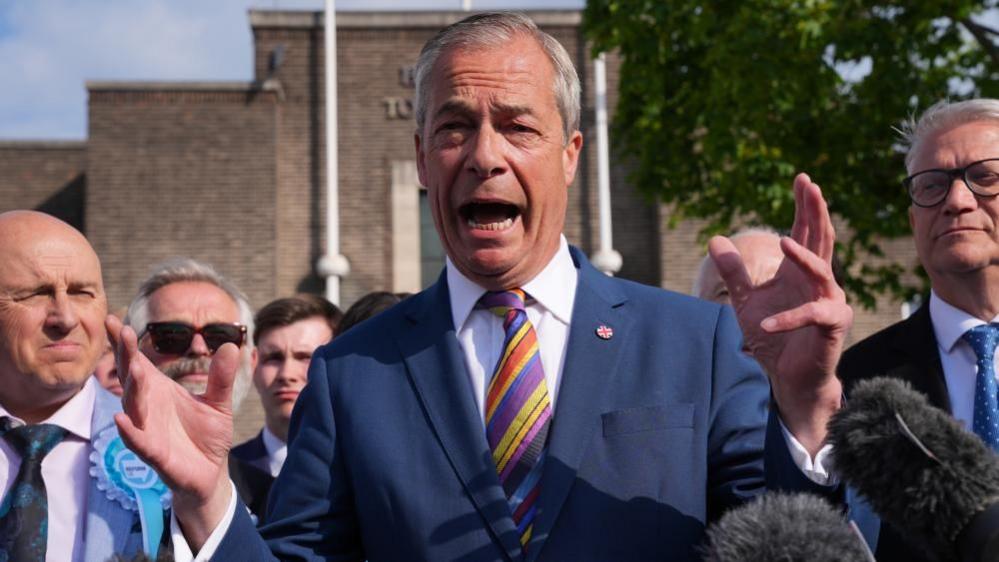
The overall tone of the debate suggested that Farage is entering a critical political phase. Some guests described him as a “front runner” and claimed his campaign for Downing Street is now effectively underway.
But others urged caution. Reform’s national vote share in some analyses reportedly dropped compared to the previous year, suggesting momentum is strong but not unstoppable.
Still, the key political reality remains: Labour is under pressure, the Conservatives are weakened, and Reform UK is now positioned as a disruptive force that could reshape the future of British politics.
Whether this represents a permanent MAGA-style transformation or a temporary protest wave may depend on what happens next — and on whether Farage can convert anger into a coherent governing alternative.
For now, Britain’s political establishment is watching closely. Because if Reform’s surge continues, the UK may be heading toward one of its most unpredictable general elections in decades.


