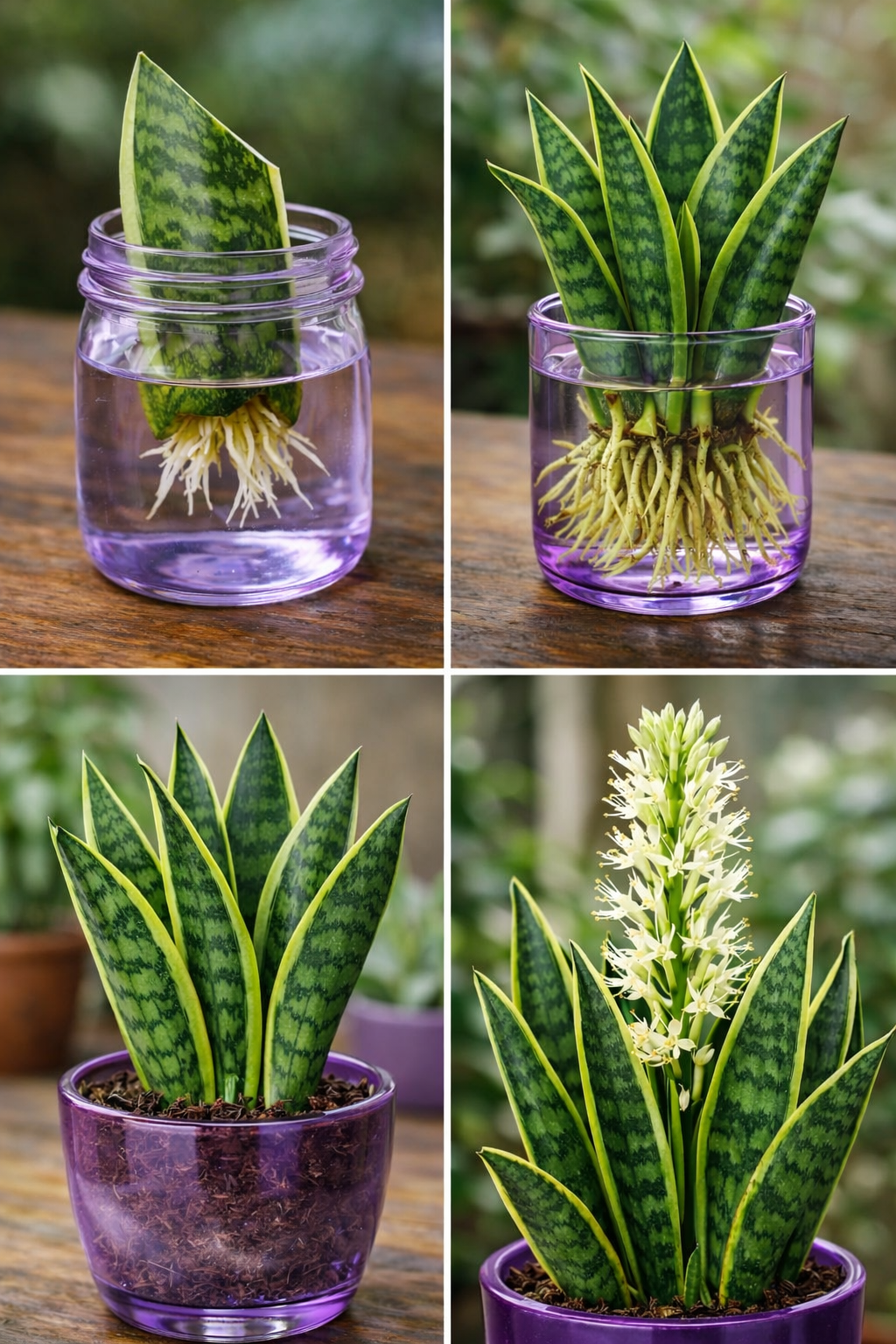
Snake plants (Sansevieria / Dracaena trifasciata) are famous for surviving almost anything — but one of the coolest and fastest ways to multiply them is by growing them in water.
And yes… it really works if you do it the right way.
Because many people try water propagation, then the leaf turns mushy, the water smells bad, and nothing roots.
In this guide, I’ll show you the real fast-rooting method that works consistently, plus the mistakes that slow rooting down, how to move it into soil, and a complete FAQ at the end.
Why Grow a Snake Plant in Water?
Water propagation is popular for 4 reasons:
✅ Fast root visibility (you see progress every week)
✅ Low effort (no soil mess)
✅ Higher success rate for beginners
✅ Looks decorative (like a living vase plant)
But here’s the truth:
Snake plants don’t root fast because of “magic water.”
They root fast when the cutting is prepared correctly — and when the water stays clean and oxygen-rich.
The Real Secret: Not All Snake Plant Cuttings Root the Same
There are two types of water propagation:
✅ 1) Whole Leaf in Water (Easiest)
You cut one full leaf and root it.
- Works great for standard green snake plants
- Takes longer to make pups (new baby plants)
- May lose the yellow edge on variegated types (important!)
✅ 2) Leaf Section Cuttings (Fastest for Multiplying)
You slice one leaf into sections.
- Produces more pups (multiple babies)
- Roots faster if done right
- Must keep the correct direction (top vs bottom)
The Fast Rooting Method That Actually Works (Step-by-Step)
Step 1: Choose the right leaf (this matters)
Pick a leaf that is:
✅ healthy and firm
✅ medium/large
✅ not bent, mushy, or yellowing
✅ taken from a strong plant
Avoid old damaged leaves — they rot faster in water.
Step 2: Make the best cut (the rooting trick)
Use a clean knife/scissors.
Best cut style:
✅ V-shape cut at the bottom of the leaf
Why?
Because it:
- increases rooting surface
- reduces rot risk
- helps roots form faster
If you’re making leaf sections: ✅ cut into 3–5 inch pieces
✅ keep track of which side was the bottom
Step 3: Let it dry (MOST people skip this)
This is the #1 reason water propagation fails.
After cutting:
✅ leave the cutting in a dry place for 24–48 hours
✅ the cut end must form a dry “callus” (protective seal)
If you put it in water immediately = rot risk becomes high.
Step 4: Use the right container (glass matters)
A clear glass jar is perfect.
✅ wide mouth
✅ stable base
✅ deep enough for 1–2 inches water
If the jar is too narrow, the leaf can wobble and damage the cutting.
Step 5: The correct water level
Here is the rule:
Only the bottom 1–2 inches should touch water.
Water propagation vases
✅ 1–2 inches water only
❌ don’t submerge half the leaf
More water = less oxygen = more rot.
Step 6: Use the best water for fast rooting
You can use:
✅ filtered water
✅ bottled water
✅ tap water left 24 hours to remove chlorine
If your tap water is very hard, use filtered.
Step 7: Place in the perfect light zone
This part decides speed.
✅ bright indirect light
Near a window, but not direct hot sun.
Direct sun can heat the jar and grow bacteria fast.
How Long Does It Take to Root?
Here’s the realistic timeline:
Week 1–2:
- cutting stays firm
- no roots yet (normal)
Week 3–5:
- small white roots appear
Week 6–10:
- thicker roots grow
- sometimes tiny pups form
2–4 months:
- baby plant (pup) starts growing
Snake plants are slow, but this method gives the best success.
How to Make It Root Faster (3 Proven Boosters)
✅ 1) Change water correctly (not daily)
You don’t need daily water changes.
Best: ✅ change water every 5–7 days
If water turns cloudy or smells: ✅ change immediately
✅ 2) Rinse the jar weekly
Even if you change the water, bacteria can stick to the jar.
✅ rinse with warm water
✅ no soap residue
✅ 3) Keep water warm (the rooting accelerator)
Snake plants root faster when warm.
Best rooting temperature: ✅ 20–27°C (68–80°F)
Cold = rooting slows down a lot.
Common Mistakes That Kill Water Propagation
❌ Mistake 1: Not letting the cutting dry
No callus = rot.
❌ Mistake 2: Too much water
Only 1–2 inches needs to touch.
❌ Mistake 3: Dirty water
Cloudy water = bacteria.
❌ Mistake 4: Using a weak leaf
A leaf already stressed won’t root well.
❌ Mistake 5: Wrong leaf direction (for sections)
If upside down = no rooting.
Can Snake Plants Live in Water Forever?
Yes… but not perfectly.
✅ They can survive long-term in water
But:
- growth will be slower than soil
- pups may be fewer
- plant can get weaker after months/years
If you want a decorative water jar plant: ✅ change water weekly ✅ add a tiny amount of hydroponic fertilizer monthly
When to Transfer Snake Plant From Water to Soil
Transfer when:
✅ roots are at least 2–4 inches long
✅ there are multiple roots
✅ plant feels stable
Best soil mix:
Snake plants hate wet soil.
Use:
- cactus/succulent soil
- perlite or pumice (30–40%)
✅ pot must have drainage holes.
Successful Transition: The Right Way
After moving to soil:
✅ don’t water immediately
Wait 3–5 days to let roots adjust.
Then water lightly
FAQ (People Ask This All the Time)
1) Why is my snake plant cutting turning mushy in water?
Because:
- cutting wasn’t dried first
- water level too high
- water not changed enough
Cut off mushy part and restart after drying.
2) Can I propagate a variegated snake plant (yellow edges) in water?
Yes, BUT:
Leaf cuttings often lose variegation.
New pups might come out green.
For keeping variegation: ✅ propagate by division (separating pups)
3) Can I use rice water or sugar water for rooting?
Not recommended.
These liquids feed bacteria and cause rot.
Plain clean water works best.
4) Can I add cinnamon to the water?
No.
Cinnamon is useful in soil — not in water jars.
5) Should I add fertilizer in water propagation?
Not at the beginning.
Wait until roots are well formed.
Then use very diluted hydroponic fertilizer monthly.
6) Why does my water smell bad?
Bacteria buildup.
✅ change water
✅ rinse jar
✅ cut the leaf end slightly and dry again if needed
7) How do I know if it’s rotting?
Rot signs:
- mushy base
- black/brown slime
- foul smell
Healthy cutting: ✅ firm and dry-looking base
8) Will it grow pups in water?
Yes — it can.
But faster pups happen after transferring to soil.
9) Can snake plant grow only in water with no soil?
Yes, but:
- slower growth
- higher maintenance (water changes)
- needs nutrients sometimes
10) What’s the fastest method overall?
Fastest real method:
✅ callus the cutting
✅ warm temperature
✅ bright indirect light
✅ weekly clean water